Tag: legionnaires

  • Legionella Update

    environmental Strategist between the lines:  In the last couple of years I have sent out more articles on Legionella than any other environmental subject.  Why, because after years of monitoring Legionella the amount of attention focusing on this pollutant has increased dramatically.

    As you will see in the links below, there are a variety of sources for Legionella and it impacts a wide spectrum of your insureds.

    Studies have shown that 40 to 60% of cooling towers have tested positive for Legionella.

    These articles will assist you to coach up your insureds on better managing and transferring their Legionella exposure.

    Don’t Be a Case Study for Legionella

    http://www.newequipment.com/plant-operations/don-t-be-case-study-legionella

    Kentucky women died from Legionnaires disease contracted at Graceland Hotel

    https://www.commercialappeal.com/story/news/2017/09/12/woman-died-legionnaires-disease-contracted-guest-house-graceland-hotel/656986001/

  • Legionnaires

    environmental Strategist, between the lines:  As we have reported in the past, Legionnaires Disease is a bacteria that can create an environmental liability for those using central air conditioning systems, fountains, room-air humidifiers, ice-making machines, whirlpool spaswater heating systems, showers, misting systems typically found in grocery-store produce sections, cooling towers used in industrial cooling systems, evaporative coolers, nebulizers, humidifiers….

    A little background:  Legionnaires is a bacteria that got its name after a 1976 outbreak at an American Legion Convention in Philadelphia.  221 people contracted the bacteria and 34 died.

    What risk management strategy are you implementing to address exposure to Legionnaires Disease for your client’s?  Pollution liability insurance can protect property owners or those with an insurable interest for their exposure to Legionnaires.

    Guests leave Las Vegas’ Rio hotel with Legionnaires’ disease

    https://www.usatoday.com/story/news/nation-now/2017/06/10/legionnaires-disease-las-vegas-rio-hotel/386558001/

  • Legionnaires

    environmental Strategist, between the lines:  As we have reported in the past, Legionnaires Disease is a bacteria that can create an environmental liability for those using central air conditioning systems, fountains, room-air humidifiers, ice-making machines, whirlpool spaswater heating systems, showers, misting systems typically found in grocery-store produce sections, cooling towers used in industrial cooling systems, evaporative coolers, nebulizers, humidifiers….

    Photo Credit: oyster.com

    A little background:  Legionnaires is a bacteria that got its name after a 1976 outbreak at an American Legion Convention in Philadelphia.  221 people contracted the bacteria and 34 died.

    What risk management strategy are you implementing to address exposure to Legionnaires Disease for your client’s?  Pollution liability insurance can protect property owners or those with an insurable interest for their exposure to Legionnaires.

    Guests leave Las Vegas’ Rio hotel with Legionnaires’ disease

    https://www.usatoday.com/story/news/nation-now/2017/06/10/legionnaires-disease-las-vegas-rio-hotel/386558001/

  • CDC Concerned Over Growth In Legionnaires Cases

    environmental Strategist, between the lines:  Legionnaires Disease is a bacteria that can create an environmental liability for those using central air conditioning systems, fountains, room-air humidifiers, ice-making machines, whirlpool spaswater heating systems, showers, misting systems typically found in grocery-store produce sections, cooling towers used in industrial cooling systems, evaporative coolersnebulizershumidifiers, windshield washers….

    A little background:  Legionnaires is a bacteria that got its name after a 1976 outbreak at an American Legion Convention in Philadelphia.  221 people contracted the bacteria and 34 died.

    What risk management strategy are you implementing to address exposure to Legionnaires Disease for your client’s?  Pollution liability insurance can protect property owners or those with an insurable interest for their exposure to Legionnaires.

    CDC officials said this new study was prompted by two factors: First, the public notoriety of cases over the last three years that included, first, the Pittsburgh VA, then a cooling tower outbreak in New York City, and, last year, the outbreak in Flint, Mich.
    CDC officials said this new study was prompted by two factors: First, the public notoriety of cases over the last three years that included, first, the Pittsburgh VA, then a cooling tower outbreak in New York City, and, last year, the outbreak in Flint, Mich.

    Legionnaires’ cases in the United States quadrupled from 2000 to 2014, with about 5,000 people a year — and probably many more — now being infected by the deadly form of pneumonia, but the exact reason for the growth is unclear, officials with the federal Centers for Disease Control and Prevention said Tuesday.

    And too many of those cases occur during an outbreak, CDC Director Tom Frieden said Tuesday in a phone call with reporters to announce the publication of a comprehensive study on outbreaks published on the CDC’s Vital Signs webpage.

    “I’ll give you the bottom line [of the study] right off the top: Almost all Legionnaires’ disease outbreaks are preventable with improvements in water system management,” he told reporters.

    During that 15-year period of 2000 to 2014, the CDC investigated 27 confirmed, land-based — as opposed to ship-based — Legionnaires’ outbreaks.

    Those outbreaks included the 2011 and 2012 Veterans Affairs Pittsburgh Healthcare System that the CDC determined infected 22 people and led to the deaths of six of them. Overall, 415 people were infected in the 27 outbreaks, and 65 of them died, the CDC said.
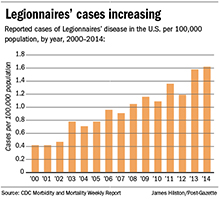
    PG chart: Legionnaires’ cases increasing
    (Click image for larger version)

    The CDC study found that in 23 of the 27 outbreaks it investigated there were “gaps in maintenance that could be addressed with a water management program to prevent Legionnaires’ disease outbreaks…”

    There were many more people sickened and killed during other outbreaks the CDC was unable to investigate during that timeframe. It noted in the study that from just 2000 to 2012, it had requests to investigate about 160 outbreaks.

    CDC officials said this new study was prompted by two factors: First, the public notoriety of cases over the last three years that included, first, the Pittsburgh VA, then a cooling tower outbreak in New York City, and, last year, the outbreak in Flint, Mich.

    In addition, last summer, after nearly a decade of work, the American Society of Heating, Refrigerating and Air-Conditioning Engineers — known as ASHRAE — completed its recommendations for dealing with the water-borne disease of Legionella in building water systems. ASHRAE’s recommendations are expected to eventually find their way into many of the country’s state or local building codes, carrying the power of law.

    Since last summer, though, the CDC “heard the ASHRAE standards weren’t easy to understand unless you were a building engineer,” Dr. Frieden said.

    As a result, the CDC on Tuesday also released an online “Toolkit” that it hopes will make adopting the ASHRAE standards easier for building owners and managers.

    The Toolkit was piloted in Flint, where the CDC took it to building owners and managers who were impacted by the outbreak there that infected 91 people — including 50 cases in a local hospital.

    In addition to the few, widely publicized outbreaks that occur annually, the CDC said it is equally concerned about the overall rise in Legionnaires’ cases, with more than 5,000 annually, nearly all of which occur without little to no publicity.

    “And we think [the number of people infected] is much higher,” said Cynthia Whitney, co-author of the Vital Signs study, “not because we don’t hear about the cases, but because we believe they’re never diagnosed.”

    The number of cases may be rising steadily for a variety of reasons, she said, including: More healthcare professionals know to look for it; better testing; a larger, more vulnerable and aging population; and a warmer climate that makes it easier for Legionella — the bacteria that causes Legionnaires’ disease — to grow.

    Victor Yu and Janet Stout, two Pittsburgh-based Legionnaires’ experts who were not involved in the CDC study, noticed in the Vital Signs report, however, that the CDC said nothing about regularly testing a building’s water for Legionella, something they have recommended for 30 years.

    “The CDC has a long history of recommending not looking for Legionella as a prospective element to assess risk,” Dr. Stout said.

    The CDC has said for decades that it believed testing regularly for Legionella would give building owners a false sense of security since people have contracted the disease when there were no signs of the bacteria in the water system.

    Dr. Whitney said there is no testing recommendation in the Vital Signs study because “we didn’t want to get into it.”

    But she said because the ASHRAE standards now recommend testing water, the CDC has now changed its position on testing since last summer.

    “We are not against testing” water for the presence of Legionella, she said. “We think it has its place, particularly in healthcare facilities.”

    Sean D. Hamill: shamill@post-gazette.com or 412-263-2579 or Twitter: @SeanDHamill.

    First Published June 8, 2016 12:00 AM

  • Legionnaires Outbreak – Are your clients properly insured?

    environmental Strategist, between the lines:  Legionnaires Disease is a bacteria that can create an environmental liability for those using central air conditioning systems, fountains, room-air humidifiers, ice-making machines, whirlpool spaswater heating systems, showers, misting systems typically found in grocery-store produce sections, cooling towers used in industrial cooling systems, evaporative coolersnebulizershumidifiers, windshield washers….As you can see, Legionnares disease has the potential to be a very large exposure for businesses. Are you clients properly insured in the event of an outbreak?

    A little background:  Legionnaires is a bacteria that got its name after a 1976 outbreak at an American Legion Convention in Philadelphia.  221 people contracted the bacteria and 34 died.

    Below is information on a recent Legionnaires outbreak in New York City which sickened more than 120 people and killed 12. What risk management strategy are you implementing to address exposure to Legionnaires Disease for your client’s?  Pollution liability insurance can protect property owners or those with an insurable interest for their exposure to Legionnaires and any 3rd parties that might be impacted.

    legionnaires-disease

    New York to deploy teams to test cooling towers amid deadly Legionnaires’ disease outbreak

    Associated Press
    By JONATHAN LEMIRE, Associated Press

    NEW YORK (AP) — State health teams will deploy to the Bronx to help collect and test samples from cooling towers amid a deadly outbreak of Legionnaires’ disease as the number of those sickened grew by one to 101, officials said Friday.

    Teams will begin work Saturday, and state officials have said they’ll pay for the testing. New York City Mayor Bill de Blasio earlier this week ordered that within the next 14 days, all buildings with cooling towers that haven’t been tested in the last 30 days be tested and any towers found contaminated be disinfected. Failure to comply is a misdemeanor. The bacteria were found in five buildings within a few blocks of one another in the South Bronx, but there is no indication that Legionella has contaminated water systems in buildings.

    “A situation like this requires a great deal of detective work. Clearly this is a sleuth mission to find out where this is happening,” said State Health Commissioner Dr. Howard Zucker.

    So far, 10 people have died since the outbreak surfaced last month, making it the deadliest in city history, health officials said. The victims were adults with underlying medical conditions. The disease is a form of pneumonia caused by breathing in mist contaminated with the Legionella bacteria.

    City Health Commissioner Mary Bassett said officials have a good handle on the outbreak, and the frequency of diagnoses is decreasing.

    “We have fewer new cases. People are seeking care promptly and getting treatment promptly. We’re optimistic that we’ve seen the worst of this outbreak, and that our remediation efforts are having an impact,” she said in a statement.

    Gov. Andrew Cuomo had asked representatives from the U.S. Centers for Disease Control and Prevention to come help, and he ordered a long-term review on how the outbreak is being handled.

    Dr. Claressa Lucas of the CDC defended the city’s response.

    “The timing of it (the response) has been very typical,” she said. “I think that they have done a very good job to mobilize their resources. I think they are taking this very seriously, and I am encourages by this response.”

    In a television interview Friday, Cuomo touted the state’s response to prevent future outbreaks, declaring, “We can’t go through this again.”

    When asked to weigh in on de Blasio’s response to the outbreak, Cuomo demurred, saying only that the “situation became critical” and warranted state assistance.

    On Friday, a homeless man who contracted Legionnaires’ disease in the Bronx filed notice with the city that he intended to file a $10 million lawsuit. Marvin Montgomery, 36, remains hospitalized and says he contracted the disease last month while passing out fliers in front of a hospital.

    His attorney, Adam Slater, said he believes the city was negligent by “failing to adequately test and monitor to look for Legionella.”

    “What you see going on right now is very reactive, which is great and hopefully prevents future outbreaks, but it shouldn’t let their past negligence off the hook for the injured people, like my client,” Slater said. “He has constant headaches, dizziness, he can barely walk and his muscles have deteriorated so much that he can’t even pick up a fork by himself.”

    A spokesman for New York City Comptroller Scott Stringer said his office closely reviews all claims.

    On average, there are about 540 cases of Legionnaires’ disease a year in New York state. The CDC estimates that 8,000 to 18,000 people are hospitalized annually with the disease in the U.S. Officials at a Cleveland hospital said Friday that a 53-year-old Ohio woman had died from the disease a day earlier.

    Source of Deadly NYC Legionnaires’ Outbreak Identified

     Marc Santia reports ~ Thursday, Aug. 20, 2015

    Health officials have identified a cooling tower at the Opera House Hotel as the source of the Legionnaires’ spike that has sickened more than 120 people in the Bronx, killing 12 of them, since July, marking the largest outbreak of the disease in New York City history.

    The tower at the Opera House Hotel was disinfected Aug. 1, authorities said. The last case reported in connection with the outbreak was reported two days later. Local, state and federal officials tested samples from 25 patients linked to the outbreak, including some who died, and in each case found a match to the strain of Legionella found in the cooling tower at the Opera House Hotel.

    Health Commissioner Mary Bassett made the announcement at an afternoon news briefing Thursday as she declared the outbreak was “over.”

    Since July 10, 128 cases of Legionnaires’ have been reported. No new cases have been reported in nearly three weeks.

    “We have not seen anyone become sick in the area of the outbreak since Aug. 3 and we are now well past the incubation period of the disease,” Bassett said.

    City, state and federal officials canvassed more than 700 sites in the south Bronx, where the outbreak was focused, in their search for the source. In total, 14 of 39 buildings with the type of cooling towers that lend themselves to Legionella growth were found to be contaminated.

    The Opera House Hotel said in a statement that it was disappointed to learn its cooling tower was the source of the outbreak.

    “It’s particularly disappointing because our system is 2 years old, has the most up-to-date technology available and our maintenance plan has been consistent with the regulations that both the city and the state are putting in place,” the statement said. “We have worked closely with both the city and the state since this issue first arose and have done everything requested to address the situation.”

    Concerns about prevention and safety prompted the city to develop and pass new legislation to regulate cooling towers, one of the locations where Legionella, the bacteria that causes the potentially severe pneumonia-like disease in people who are exposed to it, is likely to grow.

    Under the new legislation, cooling towers across the city must be tested regularly for Legionella bacteria; any found to be contaminated must be disinfected immediately. The regulations specify penalties for violations, and the legislation makes New York City the first major city in the United States to regulate cooling towers.

    Prior to the recent outbreak, no city records were kept as to which buildings had cooling towers.

    New York is now requiring the testing and inspection of building cooling towers across the state to combat Legionnaires’ disease following an outbreak in New York City that killed 12 people, Gov. Andrew Cuomo announced Monday. Ida Siegal reports (Published Monday, Aug. 17, 2015)

    The Opera House Hotel said it fully supports the new regulations.

    “We believe they are appropriate and will enhance the protection of public health. That said, we intend to go beyond the requirement to test our cooling tower every 90 days by testing every 30 days when the tower is in operation,” the statement said. “Given recent evens, we have decided to be especially cautious going forward.”

    Legionnaires’ disease usually sets in two to 10 days after exposure to the bacteria and has symptoms similar to pneumonia, including shortness of breath, high fever, chills and chest pains. People with Legionnaires’ also experience appetite loss, confusion, fatigue and muscle aches.

    It cannot be spread person-to-person and those at highest risk for contracting the illness include the elderly, cigarette smokers, people with chronic lung or immune system disease and those receiving immunosuppressive drugs. Most cases can be treated successfully with antibiotics.

    An outbreak last hit the Bronx in December. Between then and January, 12 people in Co-op City contracted the potentially deadly disease. Officials said a contaminated cooling tower was likely linked to at least 75 percent of those cases. No one died in that outbreak.