environmental Strategist, between the lines: Medical waste is a huge environmental exposure for a variety of businesses not in the medical industry. From the example in the link below of hotels, to porta john pumpers, gas stations, public government facilities, schools & colleges, sporting venues, camp grounds & parks, airports & commercial aircraft, livestock operations, restaurants & other businesses with public restrooms, homeless shelters…. With the amount of outpatient medical procedures taking place today, that means there is more medical waste generated that is not monitored for proper disposal.
Most businesses do not think about their environmental exposure to medical waste.
Juan Carlos Espinal is an experienced housekeeper at the Wyndham Boston Beacon Hill, but he is afraid to empty the garbage. On the night shift, he scans the wastebaskets for the glint of a hypodermic needle. And if he finds one, as he did recently, often there is no safe place for him to throw it away.
“When you’re cleaning, you never know what’s in that garbage can,” the 29-year-old father of two said recently in Spanish. “This is the problem.”
These and other concerns prompted a federal agency to open a new investigation into the Wyndham less than a year after the agency fined the hotel for failing to protect the housekeepers from used needles, blood, vomit, and other biohazards.
The hotel is steps from Massachusetts General Hospital and other medical facilities and offers patients a discount to stay there. But the largely immigrant housekeeping staff says the hotel made few improvements since the Occupational Safety and Health Administration fined the hotel $12,000 in November.
OSHA fined the Wyndham for failing to protect the housekeeping staff from biohazards and “physical hazards such as lacerations and puncture wounds from contact with used needles” and other sharp devices. The agency reduced the penalty to $6,000 after the hotel agreed to address the concerns.
But in August, the housekeeping staff sent another letter to OSHA saying the hotel was not consistently providing durable gloves in the correct sizes so that workers could clean rooms or gather contaminated linens. And overnight workers like Espinal had no access to special containers to safely dispose of used needles.
OSHA does not comment on pending investigations but agency spokesman Ted Fitzgeraldconfirmed that a new inspection is ongoing.
Workers say gloves are critical to their health on the job, protecting them from powerful cleaning chemicals or bloodstained sheets. If they do not have the proper size gloves, some said they avoid certain tasks or rinse their old gloves with rubbing alcohol and reuse them.
Since March, they said, at least nine staff members have worked without the proper gloves. Some have used flimsy gloves to clean rooms; others have simply gone without them.
“I’m a mother with three children. If I get sick, who is going to bring bread to my home?” said Aura Berciano, a 42-year-old who fled violence in El Salvador and has worked at the hotel for 20 years, before Wyndham purchased it a few years ago. Her husband, Jose, also cleans there.
Between them, they have cleaned rooms hundreds of times over, and said they have encountered horrific scenes. Jose said he once found a room filled with so much blood that it squished underneath his feet.
More recently, Aura said, she discovered that a colostomy bag had leaked all over a hotel room. She cleaned it up.
General Manager Tom Chmura declined to be interviewed through a spokeswoman, but the hotel issued a statement saying the OSHA investigators visited several weeks ago. The statement said all workers have access to proper equipment and supplies and are encouraged to report concerns.
“The safety and well-being of our associates and guests is paramount and measures are put in place to provide a safe and comfortable working environment,” said the statement from the Wyndham Hotel Group. “We fully cooperated with the inspectors’ inquiries. We’ll work closely with them should they have any further questions or need any additional information.”
Last year, the hotel manager cast doubt on the workers’ claims after a labor union, Unite Here Local 26, issued a critical report about the working conditions there. The hospitality workers’ union is trying to organize the Wyndham staff.
In May 2015, Chmura denied that housekeepers were working in unsafe conditions. “I think they have to be taken within the context of who’s making the allegations,” he said.
Six months later OSHA fined the hotel. Housekeepers say they sought help from the union after managers ignored their concerns.
Most of the 32-member housekeeping staff are immigrants from Haiti, the Dominican Republic, El Salvador, and other countries, and workers pointed out that until the safety concerns surfaced, they had little to bind them together. Many did not even speak the same language.
And many simply accepted the conditions, worried about losing their jobs.
Until OSHA investigated, for instance, Angela Lemus cleaned for years using latex gloves, even though a severe latex allergy left her hands bloody. After the investigators fined the Wyndham, the hotel provided latex-free gloves, but not in her size.
Now she slips her small hands into the large gloves and wipes fluids carefully to prevent them from leaking onto her hands.
“It’s so dangerous,” said Lemus, a 34-year-old mother from El Salvador.
She said she did not complain to hotel management about the gloves, because she did not believe they would fix the problem — a concern union officials echoed as well.
“These are incredibly brave people,” said Kelly McGuire, an organizer for Local 26. “They want to feel safe at work and they don’t trust the company to do anything about it.”
Some housekeepers are still uncertain about whether they want to join a union.
But Espinal, an immigrant from the Dominican Republic, said the experience has taught him about federal laws and regulations that he never learned growing up in New York. He said he dropped out of school at age 11 to work in his uncle’s bodega. Nobody ever intervened to bring him back to school, so he ended up lacking confidence in his English and unsure of his rights in America.
Now he is considering going back to school for his general equivalency diploma. “I was afraid,” said Espinal. “But not anymore. I know my rights now. I know what I’m doing.”
environmental Strategist, between the lines: Not through any nefarious act but simply to put food on our tables, the agricultural industry has created a profusion of environmental liabilities.
If you have and / or had agricultural operations in your community, chances a very good you have third party new and legacy environmental exposures impacting you.
Liabilities created by third parties is a huge environmental exposure. What is your strategy to address the third party environmental liabilities impacting you? Pollution insurance is one consideration as part of your financial assurance strategy versus self-insurance. Pollution insurance can protect you from the costs of legal fees, investigation, clean up, business interruption, disposal… created by third party liabilities.
Here is another third party environmental liability example. In the United States we have in excess of 300,000 known leaking underground storage tanks that we have no money to pay for cleanup, third party bodily injury…. My question is, how many leaking underground storage tanks don’t we know about that are impacting third parties?
California farm communities pay price for decades of fertilizer use
On a February day, a Waterford rancher made the rounds with a fertilizer and a fungicide. Ted Benson Modesto Bee file
A pollutant that has leached into California aquifers since farmers first began using synthetic fertilizer continues to accumulate and would not be removed from groundwater even if the state’s agriculture businesses abruptly quit using nitrogen-based materials to boost the productivity of their crops.
That’s one of the themes of a new study from the UC Davis Agriculture Sustainability Institute that assesses the scale and sources of a kind of pollution that can harm infants if it seeps into groundwater and contributes to respiratory problems if it drifts into the air as a gas.
The report is the widest look yet at pollution from nitrogen, a common contaminant that the State Water Quality Control Board has tried in fits and starts to remove from Central Valley agricultural communities over the past decade.
The report’s authors offer a range of solutions – from creating a cap-and-trade-style market for nitrogen emissions to encouraging better waste-management practices on farms – but they concede that it could take decades to clean up groundwater that has collected fertilizer runoff since the 1940s.
“We don’t have enough technology on the shelf to be able to address the issue now,” said sustainability institute director Tom Tomich, who led the study. “There’s a need for collaboration with farmers and ranchers to develop solutions to these challenges.”
His team took seven years to weave together a broad picture of nitrogen pollution up and down the state. Past efforts have focused on specific regions, such as a 2012 study that showed up to 250,000 people are highly vulnerable to nitrogen contamination in the Salinas and southern San Joaquin valleys.
Tomich’s study found that California generates about 1.8 million tons of nitrogen every year. More than half of it comes from agricultural sources, which rely on nitrogen as a key component in fertilizers.
Of that, about 419,000 tons leach into groundwater, where it becomes a salt known as nitrate. Overexposure to nitrates in drinking water can hurt an infant’s ability to move oxygen in the bloodstream. It’s a condition known as “blue baby syndrome.”
1.8 million tonsAmount of nitrogen released in California every year
In western Stanislaus County, the city of Modesto in 2005 built a special treatment plant to supply water to the small community of Grayson because of nitrate pollution in its wells. Delano in Kern County and Ripon in San Joaquin County also are testing new nitrate-removal processes. McFarland, also in Kern County, has had a nitrate-removal system in its water treatment plant since the 1980s.
“Communities right now are living with nitrogen water. Kids go to school and they’re told not to drink from the taps, and they’re told to buy bottled water,” said Debi Ores, an attorney for the advocacy group Community Water Center. “The problem is the communities are the ones paying the price, not the dischargers.”
Farmers and dairymen had been anticipating the release of the nitrogen assessment for some time. Many are reducing nitrogen pollution by taking steps to prevent fertilizer from going to waste or reforming their manure-management practices. Some effectively reuse nitrogen-polluted groundwater on their crops.
“This is legacy stuff,” said Danny Merkley, director of water resources at the California Farm Bureau. “It’s an issue that is really by no means a product of any nefarious act. It’s literally people doing what they were told and thought was the best practice at the time.”
The report was commissioned in part to determine whether the state should regulate nitrogen emissions as a greenhouse gas. Tomich’s team found that those emissions from agriculture are so small that they likely do not warrant new regulations.
Instead, the team determined that groundwater pollution presented the greatest potential harm to communities. Solving that problem seemed especially difficult because low-income farm communities that are under the most risk also depend on agriculture to support their economies.
“How do we provide safe groundwater for everybody?” Tomich asked. “This is an environmental justice issue. We’re talking about little kids in the Central Valley.”
He’s scheduled to brief legislative staffers on the assessment this fall.
HOW DO WE PROVIDE SAFE GROUNDWATER FOR EVERYBODY? THIS IS AN ENVIRONMENTAL JUSTICE ISSUE. WE’RE TALKING ABOUT LITTLE KIDS IN THE CENTRAL VALLEY.
Tom Tomich, director, UC Davis Agriculture Sustainability Institute
The State Water Resources Control Board, meanwhile, is considering new rules for agricultural discharges in the San Joaquin River watershed. A proposal to update the state’s irrigated lands regulatory program is moving forward with provisions for stepped-up monitoring and reporting requirements for farmers.
One controversial item would enable the state to more easily identify which farms are responsible for nitrate pollution.
An early draft of the rules elicited dozens of letters from environmental groups, farmers and farm lobbyists earlier this summer.
Some environmental groups demanded a more rigorous rule, with more penalties for farms with discharge violations. Others asked the board to refine recommendations for fertilizer management, giving farmers goals to hit in reducing nitrate pollution.
“Best practices right now might not help someone this second, but five, 10, 20 years down the road, hopefully we’ll be seeing some benefit,” said Ores, from the Community Water Center.
The majority of the letters came from farmers, who called the proposal a “duplicative” order that would ruin the agency’s hard-earned goodwill with agricultural producers. They asked for more time and more flexibility in managing vital resources for their businesses.
“Water is the lifeblood of all life. Why would we in agriculture not be responsible stewards for water and land in our care?” wrote Stockton rancher Marie Rossi.
Farms to subsidize cost of safe drinking water for those with tainted wells
A group of dairy producers in Kewaunee County says it plans to supply safe drinking water to residents with wells tainted by animal waste (Kate Golden / Wisconsin Center for Investigative Journalism)
A group of dairy producers in Kewaunee County announced Wednesday that it will pay more than half the cost of drinking water purification systems for residents whose wells have been polluted by animal waste.
The farmers and feedlot owners who belong to the private nonprofit Peninsula Pride Farms also said they would pay for bottled water for up to three months for the owner of any well in the county testing positive for E. coli bacteria.
If an inspection by a private consultant hired by Peninsula Pride finds that the well’s protective casing isn’t cracked, and the state Department of Natural Resources determines manure is probably the contamination source, the farmer group will help pay for a water treatment system.
The program is a step toward settling a long-simmering dispute over responsibility for bacterial pollution that can cause serious illness or death.
Advocates who’ve pushed for tougher regulation of the agricultural industry’s manure handling practices said the drinking water program was overdue.
Well tests conducted for about 10 years have found health hazards, including E. coli, in about 30 percent of wells tested in the county. Agricultural interests have questioned whether spreading of millions of gallons of manure annually on farm fields was the cause. But residents said a systematic county inspection and repair program has all but eliminated the possibility that faulty septic tanks were the culprit.
If the problem is a septic system or a defective well, Peninsula Pride Farms won’t pay for repairs or help cover the costs of a water treatment system.
However, if someone repairs a faulty well and a new test still finds E. coli, then assistance would be offered, said Don Niles, the owner of a 2,850-cow farm near Casco and president of the farm group.
Niles said that if the source of the E. coli isn’t entirely clear, the well owner will still be eligible for a water treatment system.
“What we are doing is owning our share,” Niles said. “We don’t want people getting sick here on our watch.”
Forty farmers formed Peninsula Pride in January to seek voluntary ways to improve environmental practices. They’ve hired a consultant to review manure handling and staged educational events. The state provided a $20,000 start-up grant, members pay dues and several businesses have contributed money for the safe drinking water effort, Niles said.
Niles estimated that as many as 40 wells — or 1 percent of the 4,000 in the county — would end up with the treatment systems, but he said there’s no way of knowing, and he’s prepared to raise more money if needed. He said he hopes that the program will mark a turning point.
“We are all scarred by the arguments and the acrimony, so it may take a while to see there’s now a way to do things other than shouting at each other,” Niles said.
DNR, county, farmer group agreement
The program will operate on terms spelled out in a memorandum of understanding between the county, the DNR and the farmer group.
DNR Secretary Cathy Stepp said in a letter dated Friday to the farm group that an alternative solution to a water treatment system in some cases could be improved “best management practices.” The state details best management practices for storage and spreading of manure, but in most cases they are mandatory only for large Concentrated Animal Feeding Operations, known as CAFOs.
“We fully support the concept that this offer does not involve any sort of admission of culpability on the part of Peninsula Pride farmers; but that it is offered to help prevent health impacts,” Stepp said in the letter, which was released by the state Dairy Business Association.
Peninsula Pride Farms said under its “Water Well” program it would cover about $1,500 of the estimated $2,250 initial cost for purchase and installation of a system that uses ultraviolet light to kill bacteria.
Well owners must obtain water tests from certified laboratories in order to qualify, and they would be required to install water softeners, which are necessary for the treatment systems to function, if they don’t already have them. The dairy group said it would pay the the estimated first-year maintenance cost of $200, but the well owner would cover the cost after that.
The Madison-based public interest law firm Midwest Environmental Advocates said the program falls short.
“We’ve asked DNR for years to use existing authority and funding in its spills program to provide clean drinking water on an emergency basis, but DNR refuses to do so,” said Sarah Geers, an MEA attorney. “Since the ‘Water Well’ program may not fully cover the cost of emergency drinking water, treatment or well replacement, it is time for DNR to step up.”
The Peninsula Pride announcement comes about two years after residents petitioned the U.S. Environmental Protection Agency to force the state into actions that would remedy the problem in Kewaunee County, where there is a high concentration of CAFOs and porous bedrock that leaves groundwater vulnerable.
The EPA in March urged state regulators to make it a priority to deliver clean water to those without it. A DNR-funded study aimed at determining the source of the contamination is ongoing.
The EPA’s regional administrator said on Aug. 17 that an announcement about provision of drinking water was coming soon.
Kewaunee County at center of conflict
Kewaunee County has become one of several centers of heated conflict between farming interests and residents upset about the poor quality of groundwater, lakes and streams.
Residents have filed a series of lawsuits aimed at compelling the DNR to enforce laws and set stricter standards.
Gov. Scott Walker and the Legislature have curtailed DNR budgets and its authority to set and enforce standards for polluters.
Residents and conservation groups in 2014 petitioned the EPA to use emergency powers to protect public health in Kewaunee County. Federal officials worked with the DNR to form “workgroups” that studied potential solutions and issued a report in June.
Midwest Environmental Advocates has asked the DNR several times since October to review its legal analysis indicating the department could supply drinking water when wells are poisoned by animal waste, according to email exchanges the group released.
And in a March 28 letter, acting regional EPA administrator Robert Kaplan told Stepp that while the state agency was making a comprehensive plan to prevent further contamination, it was important to make sure residents had safe water.
In November, tests funded by the DNR of 320 randomly selected wells found 110 exceeded standards for total coliform or nitrate, both of which can come from manure or other sources, such as faulty septic systems.
The Mergers, Acquisitions in the ERMI MAPP program, depicts the Representations and Warranties coverage. As the link below points out, representations are statements about the current status of the business or its operations. Warranties go further than representations about current status because they guarantee the truth of the statements.
The need for MAPP with M&A’s is unquestioned since breached representations and warranties are the most common cause of litigation in acquisitions.
To give you a better understanding of representation & warranties, the link below offers a general list and explanation of common representations and warranties that will be contained in M&A documents.
As part of our continual effort to provide the best service possible, you spoke up, and we listened. We had a number of agents request applications which could be completed on their computers rather than having to print them out. Below are links to our new and improved applications! Please let us know what we can do to better serve you, we are always listening for ways we can improve. We want to be your GO TO for all things Environmental and M&A!
environmental Strategist®, between the lines: As an environmental Strategist®, the number one pushback we hear from a business with regard to strategizing on managing and transferring their environmental exposures is, “We do not have any environmental exposures in our business.”
We know every business is impacted by environmental exposures, but instead of getting confrontational, I have found the best comeback to anyone who believes they do not have any environmental exposures impacting their business is to agree with them and then ask, do you have any neighbors that have environmental exposures associated with their business? What if a neighboring business had an environmental loss and it impacted you? When they do a Phase I site assessment they do a minimum of a 2 mile radius search to determine if there are any properties within a 2 mile radius that could cause an environmental loss and impact neighboring properties.
The story below is just one simple example of how vapor intrusion / air emissions from a neighboring property can impact businesses causing sick building syndrome.
eS Risk Management Strategies:
When meeting with a business that does not believe they have any environmental exposures, explain to them that in a Phase I site assessment they do a minimum of a 2 mile radius search to see if any neighbors could contaminate their property. Ask them to pull up Google maps satellite and type in their address. Now ask them scan back to a 2 mile radius from their property. Lastly, ask them how confident they feel that no neighbors within that two mile radius will contaminant their property? What is their strategy should a third party contaminate their property? Pollution liability insurance can protect property owners should neighboring third parties contaminate their property.
In preparation for a meeting to strategize on managing and transferring environmental exposures go to the EPA website: https://echo.epa.gov/. At the EPA ECHO website you can type in a street address, a city, a county / perish… and it will give you a list of businesses / property owners that have or currently are involved in a cleanup or environmental violations. Sharing a list of the neighboring properties is a great way to show that a credible source, the government, has identified contaminating neighbors and if the government knows about it, shouldn’t it be of concern to them. What is their strategy?
News Releases from Region 03
PHILADELPHIA (July 21, 2016) – The U.S. Environmental Protection Agency announced today that Sunshine Pride Dairy, Inc. will pay a $179,074 penalty to settle alleged federal environmental violations at its former cheese processing facility in Winchester, Va. The dairy shut down cheese processing operations in December 2011, but left anhydrous ammonia, a hazardous substance, stored in its refrigeration system with only a skeleton maintenance crew at the facility.
EPA alleged that in July 2012, the facility did not properly notify emergency response agencies about two instances when anhydrous ammonia was released into the air. These included one release of between 100-500 pounds and another of more than 1,500 pounds. After the second release, Sunshine Pride Dairy had the remaining anhydrous ammonia drained from the system.
EPA cited the company for not updating its operating procedures to reflect current conditions at the facility, failing to document proper training of its operators, and failing to maintain its ammonia processing equipment. In addition, EPA also alleged that the dairy did not report the ammonia to the state, county and local fire department as required on its annual chemical reporting forms for the years 2012 and 2013.
The settlement resolves alleged violations under three federal statutes: failing to maintain risk management obligations required under the Clean Air Act Section 112(r); failing to comply with community right-to-know reporting requirements; and failing to report releases to the National Response Center, as required by the Comprehensive Environmental Response, Compensation, and Liability Act.
These requirements help to ensure safeguards are in place to protect the health and safety of workers, local residents and the environment. It’s also essential that local, state and national emergency response authorities are notified immediately when a release of hazardous substances occurs, so they can respond quickly and effectively.
As a part of the settlement, the company did not admit or deny EPA’s allegations.
environmental Strategist, between the lines: Reputational risk associated with environmental liabilities can devastate a business.
Besides reputational risk, environmental liabilities create financial stress due to clean up, legal costs, investigation costs, third party bodily injury, third party property damage, third party business income and much more. Since every business is impacted by environmental exposures and at least 90% of the businesses in the United States can’t afford to self-insure the environmental exposures impacting their operations, pollution liability insurance has proven to be a sound investment versus self-insuring.
Refrigerants make air conditioning and refrigeration possible.
What businesses do you work with that have this same environmental exposure as Trader Joes due to their use of refrigeration systems? Agriculture operations, food processors, restaurants, resorts, educational institutions, transportation / logistics companies, warehouses, convenience stores / gas stations, contractors that service refrigeration systems / HVAC, commercial real estate owners, medical facilities, laboratories, ice rinks and many, many more.
Trader Joe’s penalized $500,000 over refrigerant leaks
Trader Joe’s, the boutique supermarket chain known for its healthy and exotic foods, has agreed to a $500,000 settlement arising from leaky refrigeration systems that contribute to global warming under an agreement with the federal government.
The chain is expected to spend an additional $2 million over the next three years as part of a settlement announced Tuesday by the Justice Department and Environmental Protection Agency to improve the equipment at 453 stores nationwide. The stores have been leaking a coolant called R-22, which government attorneys say depletes the ozone layer and is a greenhouse gas. They had alleged the leak violates the Clean Air Act and federal stratospheric ozone regulations.
“Some of the refrigerants now in use by Trader Joe’s are up to 4,700 times more potent than carbon dioxide,” said Alexis Strauss, acting regional administrator for EPA’s Pacific Southwest region. “Today’s settlement will affect all of Trader Joe’s current and new stores to prevent the release of approximately 31,000 metric tons of carbon-equivalent greenhouse gases.”
National Director of Public Relations for Trader Joe’s, Alison Mochizuki, released the following statement regarding the settlement: “Trader Joe’s looks forward to working with the EPA in its mission to reduce air pollution and protect the ozone layer, and, with this agreement, has committed to reducing its emissions to a rate that matches the best of the industry.”
Trader Joe’s, based on Monrovia, Calif, becomes the third grocery chain to face concerns about refrigerant leaks. Previous cases have been filed against Safeway and Costco Wholesale for similar leaks of ozone-depleting refrigerants since 2013. All three companies are also being required to heighten their leak monitoring and recordkeeping, as well as electronic reporting to the EPA.
FOR IMMIDIATE RELEASE 6/23/16 – ENVIRONMENTAL RISK MANAGERS, INC. (ERMI) INTRODUCES MAPP PRODUCT TO ADDRESS TRANSACTIONAL RISKS
Environmental Risk Managers, Inc. has announced a new product to address exposures related to business & property transactions. The Mergers, Acquisitions, and Pollution Protection (MAPP) product combines Representations & Warranties (R&W) Insurance with Pollution Liability Insurance.
For those not familiar with R&W insurance, it’s designed to provide coverage for the breach of a representation or a warranty contained in a Buy / Sell Agreement, in addition to, or as a replacement for all or most of the seller’s contractual representations and warranties.
Brooks Bunbury, Vice President of ERMI, sees a growing need for a combined product to address the environmental and transactional exposures created via indemnifications in standard buy/sell agreements. “Over the last decade we have seen a steady increase in the number of M&A deals (Mergers & Acquisitions) which require Pollution Liability Insurance for deals to close. Over this same time, we have seen a growing interest in incorporating R&W Insurance into M&A transactions as well. As a general rule, R&W policies typically exclude coverage for pollution.” Mr. Bunbury went on to explain, “At the end of the day, all sides of the deal want a clean transaction. By offering R&W, Tax Liability, and Pollution Liability Insurance individually, or combined in a package, our new MAPP product does just that. It allows all parties to go their separate ways while reducing the risk of un-forecasted liabilities arising from the transaction”
Insurance industry data has revealed that one out of every four M&A deals has at least one claim of a breach of the reps and warranties after closing. “As we have seen from environmental indemnifications in transactional documents, if there’s not a pre-determined financial assurance mechanism in place, the environmental indemnification that the seller agrees to may not be worth the paper it’s written on.”
“In the past, the response to an issue after closing has been to negotiate around the problem. Unfortunately, negotiating is expensive, time consuming and rarely brings about the most desirable outcome for all involved parties. MAPP addresses the unknowns by providing financial assurance should a problem arise after closing, therefore creating a cleaner transaction with less risk. With MAPP, ERMI has raised the bar on financial assurance for M&A deals.”
Environmental Risk Managers, based in Leland, Michigan was founded in 1992 as a specialty Environmental Liability Insurance wholesaler. With an emphasis on education, ERMI combines their product knowledge with superior marketing to provide the highest level of service in the industry.
“We’re excited to leverage our proven strategies in the Pollution Liability Insurance market to support companies with their transactional insurance needs.”
For more information, please contact Brooks Bunbury with Environmental Risk Managers.
environmental Strategist, between the lines: Legionnaires Disease is a bacteria that can create an environmental liability for those using central air conditioning systems, fountains, room-air humidifiers, ice-making machines, whirlpool spas, water heating systems, showers, misting systems typically found in grocery-store produce sections, cooling towers used in industrial cooling systems, evaporative coolers, nebulizers, humidifiers, windshield washers….
A little background: Legionnaires is a bacteria that got its name after a 1976 outbreak at an American Legion Convention in Philadelphia. 221 people contracted the bacteria and 34 died.
What risk management strategy are you implementing to address exposure to Legionnaires Disease for your client’s? Pollution liability insurance can protect property owners or those with an insurable interest for their exposure to Legionnaires.
CDC officials said this new study was prompted by two factors: First, the public notoriety of cases over the last three years that included, first, the Pittsburgh VA, then a cooling tower outbreak in New York City, and, last year, the outbreak in Flint, Mich.
By Sean D. Hamill / Pittsburgh Post-Gazette
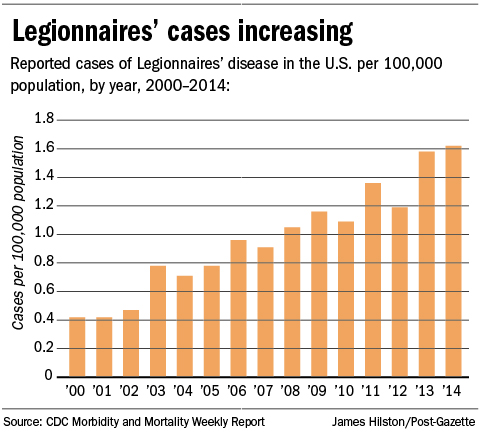
Legionnaires’ cases in the United States quadrupled from 2000 to 2014, with about 5,000 people a year — and probably many more — now being infected by the deadly form of pneumonia, but the exact reason for the growth is unclear, officials with the federal Centers for Disease Control and Prevention said Tuesday.
And too many of those cases occur during an outbreak, CDC Director Tom Frieden said Tuesday in a phone call with reporters to announce the publication of a comprehensive study on outbreaks published on the CDC’s Vital Signs webpage.
“I’ll give you the bottom line [of the study] right off the top: Almost all Legionnaires’ disease outbreaks are preventable with improvements in water system management,” he told reporters.
During that 15-year period of 2000 to 2014, the CDC investigated 27 confirmed, land-based — as opposed to ship-based — Legionnaires’ outbreaks.
Those outbreaks included the 2011 and 2012 Veterans Affairs Pittsburgh Healthcare System that the CDC determined infected 22 people and led to the deaths of six of them. Overall, 415 people were infected in the 27 outbreaks, and 65 of them died, the CDC said.
PG chart: Legionnaires’ cases increasing (Click image for larger version)
The CDC study found that in 23 of the 27 outbreaks it investigated there were “gaps in maintenance that could be addressed with a water management program to prevent Legionnaires’ disease outbreaks…”
There were many more people sickened and killed during other outbreaks the CDC was unable to investigate during that timeframe. It noted in the study that from just 2000 to 2012, it had requests to investigate about 160 outbreaks.
CDC officials said this new study was prompted by two factors: First, the public notoriety of cases over the last three years that included, first, the Pittsburgh VA, then a cooling tower outbreak in New York City, and, last year, the outbreak in Flint, Mich.
In addition, last summer, after nearly a decade of work, the American Society of Heating, Refrigerating and Air-Conditioning Engineers — known as ASHRAE — completed its recommendations for dealing with the water-borne disease of Legionella in building water systems. ASHRAE’s recommendations are expected to eventually find their way into many of the country’s state or local building codes, carrying the power of law.
Since last summer, though, the CDC “heard the ASHRAE standards weren’t easy to understand unless you were a building engineer,” Dr. Frieden said.
As a result, the CDC on Tuesday also released an online “Toolkit” that it hopes will make adopting the ASHRAE standards easier for building owners and managers.
The Toolkit was piloted in Flint, where the CDC took it to building owners and managers who were impacted by the outbreak there that infected 91 people — including 50 cases in a local hospital.
In addition to the few, widely publicized outbreaks that occur annually, the CDC said it is equally concerned about the overall rise in Legionnaires’ cases, with more than 5,000 annually, nearly all of which occur without little to no publicity.
“And we think [the number of people infected] is much higher,” said Cynthia Whitney, co-author of the Vital Signs study, “not because we don’t hear about the cases, but because we believe they’re never diagnosed.”
The number of cases may be rising steadily for a variety of reasons, she said, including: More healthcare professionals know to look for it; better testing; a larger, more vulnerable and aging population; and a warmer climate that makes it easier for Legionella — the bacteria that causes Legionnaires’ disease — to grow.
Victor Yu and Janet Stout, two Pittsburgh-based Legionnaires’ experts who were not involved in the CDC study, noticed in the Vital Signs report, however, that the CDC said nothing about regularly testing a building’s water for Legionella, something they have recommended for 30 years.
“The CDC has a long history of recommending not looking for Legionella as a prospective element to assess risk,” Dr. Stout said.
The CDC has said for decades that it believed testing regularly for Legionella would give building owners a false sense of security since people have contracted the disease when there were no signs of the bacteria in the water system.
Dr. Whitney said there is no testing recommendation in the Vital Signs study because “we didn’t want to get into it.”
But she said because the ASHRAE standards now recommend testing water, the CDC has now changed its position on testing since last summer.
“We are not against testing” water for the presence of Legionella, she said. “We think it has its place, particularly in healthcare facilities.”
Sean D. Hamill: shamill@post-gazette.com or 412-263-2579 or Twitter: @SeanDHamill.
environmental Strategist®, between the lines: In follow up to our recent article on “Natural Disaster Seasons Are a Great Time To Talk Pollution Insurance”, please see the article below that reviews pollution liabilities created by wildfires. These same contaminants are released during a residential or commercial building fire.
Fire policies typically exclude coverage for the cleanup of resulting contamination caused by a fire. Since the majority of real estate owners cannot afford to self-insure their exposure to pollution liabilities as a result of a fire, what is their risk transfer strategy? Pollution insurance fills in the gap created by fire policies excluding pollution resulting from a fire. Any insureds who own property need to have a strategy in place for handling the aftermath of a fire.
Research from California fires that have burned through homes and communities suggests such blazes leave a threatening legacy of caustic ash and toxic heavy metals. (Scott Olsen/Getty Images)
Fort McMurray wildfire will leave toxic legacy, experts say
Mixed with water, ash almost as caustic as oven cleaner, U.S. Geological Survey says
By Bob Weber, The Canadian PressPosted: May 09, 2016 1:22 PM MT Last Updated: May 09, 2016 2:12 PM MT
Danger from the Fort McMurray wildfire that has destroyed entire city blocks in the northern Alberta city won’t end when the flames stop.
Research from California fires that have burned through homes and communities suggests such blazes leave a threatening legacy of caustic ash and toxic heavy metals.
“There’s no doubt, it is hazardous,” said Scott Stephens, a fire scientist at the University of California Berkeley.
California has sad experience with wildfires raging through urban areas. Every summer, said Stephens, the state loses homes to marauding flames from the woods.
Wildfires big and bad enough to force their way into communities are generally hot enough to burn off hydrocarbons such as vinyl siding, nylon carpets or household chemicals.
“Fires really do incinerate most of that material,” Stephens said. “No doubt that has an impact on air quality, but the vinyls, the tires, the materials that you’d never think would burn … most of that stuff is gone.”
House fires can burn for more than an hour at temperatures reaching 1,500 C, he said.
“You’ll look and try and find your dishwasher or your refrigerator. You might find its motor, you might find a few things, but a lot of it has just disappeared.”
But the ash left behind poses real threats.
The U.S. Geological Survey found ash left after California’s home-destroying wildfires in 2007 and 2008 was far more alkaline than ash from wood fires. Mixed with water, the ash was almost as caustic as oven cleaner.
Ash contaminated with heavy metals
It was also significantly contaminated with metals, some of them toxic. Arsenic, lead, antimony, copper, zinc and chromium were all found at levels exceeding Environmental Protection Agency guidelines.
Ash particles from urban-wildfire blazes tended to be smaller and more easily inhaled. Both arsenic and hexavalent chromium — a form of the metal known to cause lung cancer — were more readily taken up by lung fluids than they were in water.
Many counties treat ash from such fires as hazardous waste, said Geoff Plumlee, a geochemist who conducted much of the U.S. research.
“When large numbers of buildings burn, that does create a situation where there’s potential for much higher levels of metals to get out into the environment.”
California experts say anyone returning to a home burned in a wildfire should dress protectively — long sleeves and pants, gloves, boots, masks and goggles. People are urged to stir up the ash as little as possible.
Alberta’s last experience with a forest fire destroying homes came in Slave Lake, where more than 400 homes and other buildings were levelled in 2011 — about one-quarter as many as were burned in Fort McMurray. The ash from that fire was disposed of as hazardous waste.
Tests of the ash found lead, a powerful neurotoxin especially dangerous to children, was at three times the recommended levels for residential soils. Dioxins and furans, some of which are highly potent carcinogens, were anywhere from 13 to 52 times the guideline levels.
Government officials argued the ash shouldn’t be held to the same standards as soil and said the ash was not a health risk. But scientists at the time questioned that assessment.
Plumlee emphasized that risks are manageable and fade over time. Ash quickly becomes less caustic when it mixes with small amounts of carbonic acid in rainfall.
But the risks are real.
“It’s not alarmist at all. We don’t really know if there are long-term effects,” he said. “(But) there are common-sense things people can do to minimize their exposure.”
environmental Strategist, between the lines: Studies have stated agriculture accounts for 80% of the worldwide fresh water consumption and contaminates 70% of our waterways. However, each and every one of us depend upon agriculture. Understanding that just by their very existence agricultural operations are polluters, the question becomes how can agricultural operations pollute in a way that has the least amount of impact upon human health and the environment?
The article below highlights a growing trend in the livestock industry. As you go through the article, I have highlighted in red the pollution insurance coverage appropriate for the various environmental exposures.
Cows eat at Scenic View Dairy in Fennville on Tuesday, April 19, 2016. The farm produces its own electricity with an anaerobic digester which runs on methane from manure. (Neil Blake | MLive.com)
Dairy Farm Produces Electricity From Manure
FENNVILLE, MI – Brian Geerlings estimates his 2,000 cows produce enough milk (milk has been classified as a pollutant so Environmental Impairment Liability (EIL) site pollution coverage for the dairy farm and transportation pollution insurance to get the milk to the producer / consumer) each day to supply each resident of Grand Rapids with an 8-ounce glass of milk.
But that’s not all his cows produce. Thanks to three “anaerobic digesters” that process the manure on the “back end” of the farm, the Scenic View Dairy also generates enough electricity to power more than 700 homes.
“We’re able to produce our milk with a negative carbon footprint,” says Geerlings, a 36-year-old farmer who moved his Scenic View Dairy to Allegan County from the Zeeland area in 2000 to escape the urban sprawl that inhibited expansion.
The cows are milked three times a day (Before a cow can be milked they must be washed which produces contaminated waste water. Washing consumes approximately 40 gallons per cow per day. Waste water from washing cows accounts for the majority of waste in manure lagoons. EIL coverage will address these exposures) eating from a carefully blended mix of silage designed to give them the optimal amount of protein, fiber and nutrients. “It’s calculated to produce milk,” says Geerlings, who estimates each cow eats about 110 pounds each day.
Housed in open-air barns (Air emissions from cows methane, which makes up 10 – 15% of global methane emissions. EIL coverage for this exposure) designed to keep them comfortable and out of the weather, each cow’s milk output is individually weighed and recorded.
“We have records from the day she’s born until the day she dies,” said Geerlings, who said the herd produces about 18,000 gallons of milk each day – about 75 pounds per cow.
After it leaves the cow, the milk is piped into a chiller (Many agricultural products, like milk, need to be kept cold which involves refrigerant chemicals that can release air emissions or spill fluids. EIL coverage.) and transported within 24 hours by truck to a milk processing plant in Reed City, where it is converted into Yoplait yogurt, or Coopersville, where it dried and used in the food processing industry or sent overseas. (Products pollution exposure. Generally, the environmental liability insurance market does not like to offer this coverage on consumable products.)
That’s on the front end. What makes Geerlings’ farm unusual is his handling of the cows’ manure, which has historically been treated as a smelly nuisance (EIL coverage).
At Scenic View Dairy, the manure is treated like gold. While the cows are in the milking parlor, their manure is scraped into holding tanks and sent to one of three large green silos (EIL coverage for the storage), where it is heated over a 22-day period.
The heating process causes the slurry to emit methane gases that are captured by the large cones. As a bonus, capturing the methane gas also eliminates much of the smell associated with the farm. (EIL coverage for air emissions)
The captured methane is used to fuel two 12-cylinder Caterpillar motors that run round-the-clock (EIL for air emissions) to drive electrical co-generators that supply electricity for the farm and are fed back into the grid operated by Consumers Energy.
Besides eliminating an electrical bill that could reach up to $15,000 a month, Geerlings estimates he sells about two-thirds of the electricity generated by the farm back to Consumers Energy. “We just renewed our 20-year contract with Consumers,” he said.
The farm’s negative carbon footprint also allows Geerlings to sell “carbon credits” to companies who need to offset their carbon consumption. While the market price of carbon credits fluctuates, Geerlings estimated he pockets about $50,000 a year from their sale.
After the methane is extracted, liquid is expelled from the manure and returned to the barns for bedding. Some of the “bio-mulch” also is sold to landscape companies for mulch or soil conditioners. (Depending upon how the bio-mulch is stored you can have a storm water runoff exposure along with the transportation pollution liability exposure to get mulch to landscape companies and consumers. EIL and transportation pollution liability coverage. Potential products pollution exposure.)
The liquid from the manure is stored in lagoons (EIL coverage) and injected back into the 3,200 acres (EIL coverage) which Geerlings owns or rents (Depending upon the rental agreement this could be site pollution coverage or Contractors Pollution Liability (CPL).) in the area to raise corn, soybeans, wheat and rye (EIL coverage for the storage and application of other agricultural chemicals used in order to grow these crops.). Much of those crops are fed back to the herd.
The digesters not only add cash to Geerlings’ bottom line, but also stabilizes his balance sheet when dairy prices fluctuate.
“There are times in the past year when the digester has made more than the cows,” says Geerlings, who employs 35 full-time workers. “It takes dedication and it takes focus to make it pay.”
Jim Harger covers business for Mlive Media Group. Email him at jharger@mlive.com


 Download article as a PDF